
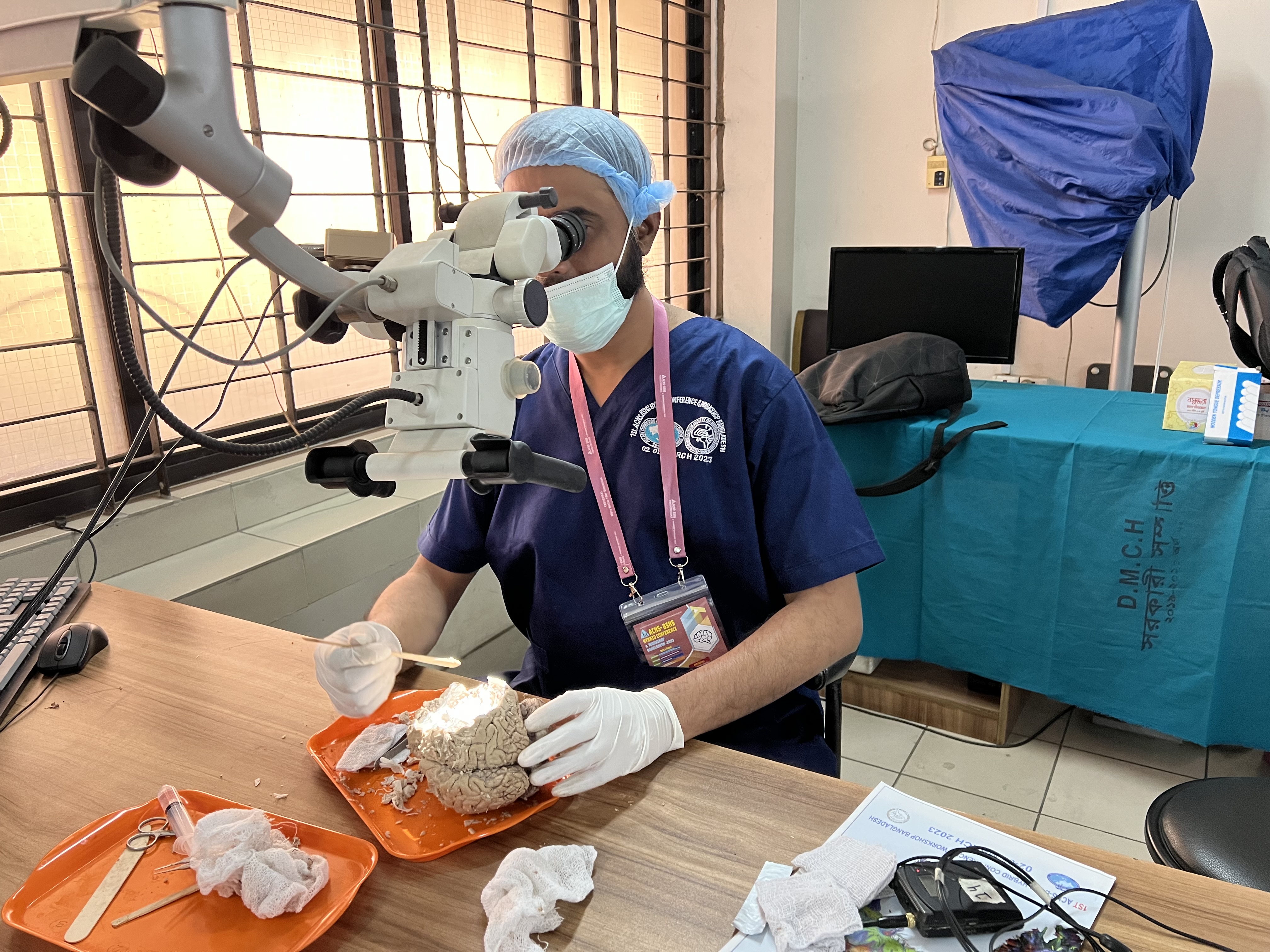
Neurosurgery School Banner

Neurosurgery
Learning School

Videos for neurosurgeons to learn from actual
clinical cases and advanced surgical techniques

Surgical Case Studies & Video Library

Endoscopic Brain Surgery

Endoscopic Endonasal Approach for Pituitary Adenoma Recurrency

Clinical Presentation

A 48-year-old male presented with bitemporal hemianopsia and visual acuity decline. MRI revealed a recurrent pituitary macroadenoma with suprasellar extension.

Surgical Approach

Transnasal transsphenoidal endoscopic approach. Fully resected with preservation of the pituitary stalk and optic chiasm.

Key Takeaways & Learning Points

  • Gland dissection without mucosal injury
  • Identification of carotid canal & cavernous sinus landmarks
  • Skull base reconstruction using nasoseptal flap
Spine Surgery

Microscopic Anterior Cervical Discectomy and Fusion (ACDF)

Clinical Presentation

A 35-year-old female suffering from severe left C6 radiculopathy and neck pain, refractory to conservative therapy for 6 months.

Surgical Approach

Anterior neck incision along skin crease, retraction of trachea/esophagus, discectomy under operating microscope, and insertion of PEEK cage.

Key Takeaways & Learning Points

  • Safe retraction and protection of recurrent laryngeal nerve
  • Complete decompression of bilateral neural foramina
  • Proper placement of graft under continuous fluoroscopic monitoring
Brain Tumour Operation

Awake Craniotomy for Motor Strip Glioma Resection

Clinical Presentation

A 41-year-old right-handed patient presenting with focal seizures. MRI demonstrated a low-grade glioma adjacent to the left precentral gyrus.

Surgical Approach

Awake craniotomy with cortical mapping, sensory-motor monitoring, and maximal safe surgical resection.

Key Takeaways & Learning Points

  • Establishing patient rapport and anesthetic block
  • Direct cortical stimulation to identify functional motor pathways
  • Intraoperative monitoring of motor speech during resection
Skull Base Surgery

Microvascular Decompression (MVD) for Trigeminal Neuralgia

Clinical Presentation

A 55-year-old patient with severe, stabbing electric-shock-like pain in the right V2/V3 distribution, failing high-dose carbamazepine.

Surgical Approach

Suboccipital craniotomy, cerebellopontine angle dissection, identification of superior cerebellar artery compressing CN V.

Key Takeaways & Learning Points

  • Gentle cerebellar retraction using dynamic suction/spatula
  • Detailed dissection of arachnoid around CN V root entry zone
  • Secure Teflon felt insertion between artery and nerve root
Endoscopic Brain Surgery

Endoscopic Third Ventriculostomy (ETV) for Aqueduct Stenosis

Clinical Presentation

A pediatric patient with worsening hydrocephalus and signs of elevated intracranial pressure secondary to congenital aqueductal stenosis.

Surgical Approach

Right frontal burr hole, ventriculoscopic access, fenestration of the third ventricle floor, and cisternostomy.

Key Takeaways & Learning Points

  • Identification of mammillary bodies and infundibular recess
  • Safe perforation using blunt probe/balloon catheter
  • Check of basilar artery integrity prior to fenestration dilation
Spine Surgery

Surgical Excision of Intradural Extramedullary Spinal Tumour

Clinical Presentation

A 50-year-old female with progressive paraparesis, sensory deficit below T6, and thoracic spine MRI showing a thoracic meningioma.

Surgical Approach

Posterior midline incision, T5-T7 laminectomy, dural opening, tumor dissection from spinal cord, and complete resection.

Key Takeaways & Learning Points

  • Pia-arachnoid plane dissection to prevent cord traction
  • Safe coagulation of tumor dural attachment base
  • Watertight dural closure with running suture